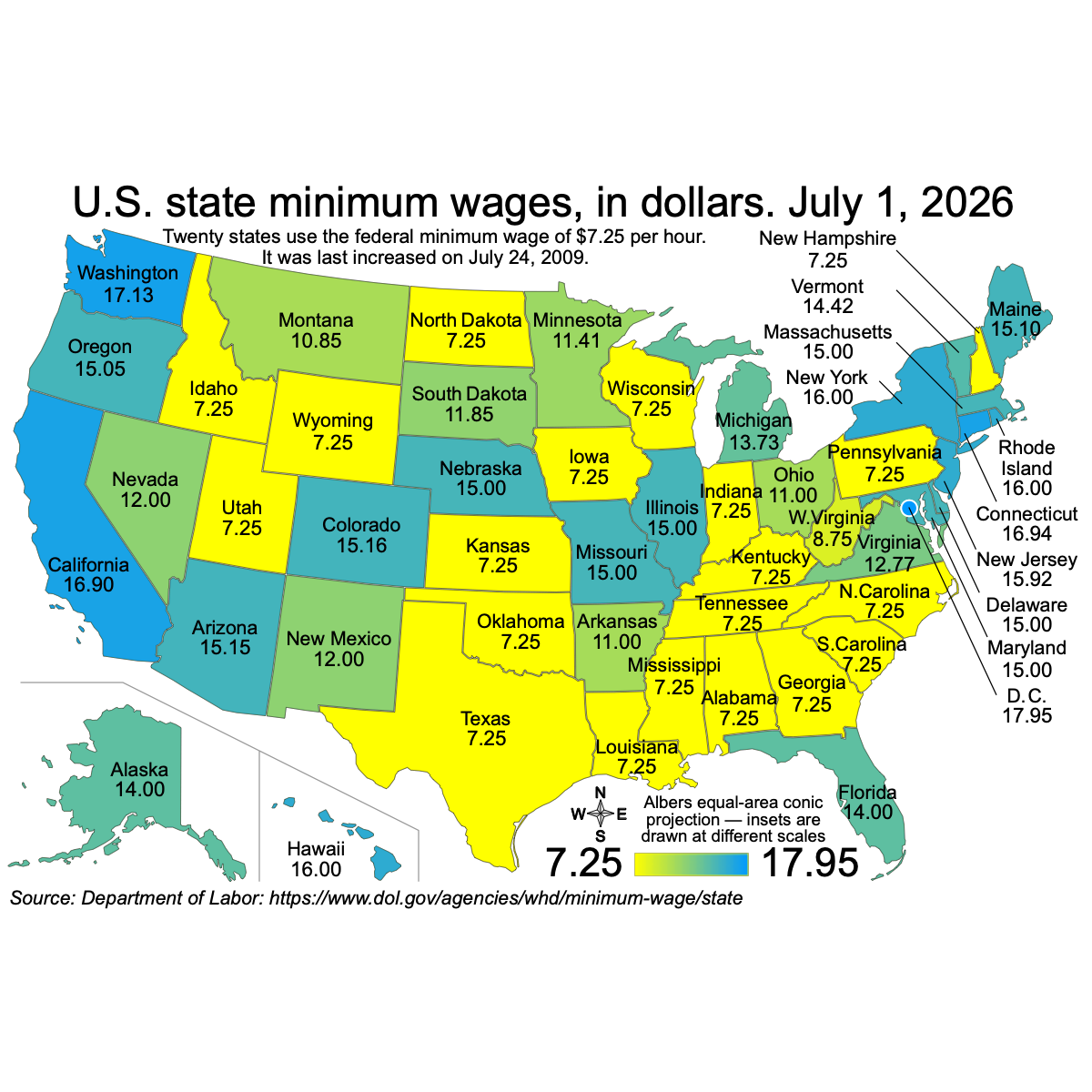
Starting January 1, workers in 88 jurisdictions — 22 states and 66 cities or counties — will see a bump in their minimum wage, with four more states and 22 additional cities following later in the year. Washington State tops the list at $17.13 an hour; Connecticut follows close behind at $16.94; California lands at $16.90. New York City, Long Island, and Westchester climb to $17.00, while the rest of New York settles for $16.00. Sixty jurisdictions will clear $15 an hour once the dust settles, and three states plus forty localities will sit at $17 or above.
Read that paragraph again and notice what it doesn't mention: what any of that money will actually buy. That's the trouble with treating a wage floor as the whole conversation. A raise measured only in nominal dollars, against a currency the federal government has spent decades diluting through deficit spending and money creation, is not the same thing as a raise measured in what a worker can put in a cart at the grocery store. Somewhere between the press release and the paycheck, a good chunk of that increase gets quietly eaten.
To be fair to the states doing this: they're not wrong that $7.25 an hour — the untouched federal floor since 2009 — is a number from a different economy, one where rent, groceries, and everything else cost meaningfully less. States and cities have moved on their own, through ballots and legislation, precisely because Congress hasn't touched the federal minimum in seventeen years. That's not activism outrunning consensus — that's local governments doing the job national government abdicated. I have plenty of criticism for state legislatures, but "we noticed Washington stopped functioning and did something ourselves" isn't one of my complaints.
Still, the pattern across these 88 jurisdictions is instructive in a way that goes beyond partisan wage-floor arguments. Look at the mix: Ohio moves to $11.00, Minnesota to $11.41, Montana to $10.85 — all real increases, and all still well under the $16-$17 range coastal states are setting. That's not an accident; it reflects genuinely different costs of living, which is itself evidence that a single federal number was always going to be a blunt instrument. Local wage-setting, whatever its flaws, at least engages with the actual price of living somewhere, rather than legislating a number in Washington disconnected from ground truth in Toledo or Bozeman.
- Washington State: $17.13/hour
- Connecticut: $16.94/hour
- California: $16.90/hour
- New York City/Long Island/Westchester: $17.00/hour
- Ohio: $11.00/hour
- Montana: $10.85/hour
None of these numbers are fake, and none of these raises are nothing — a worker in Hayward, California, going from whatever they made last year to $17.79 an hour will feel that in a real way, at least for a while. But "for a while" is doing a lot of work in that sentence. If the dollar keeps losing purchasing power at the pace it has, this time next year we'll be having the identical conversation about the next round of increases needed just to stand still. A minimum wage chasing inflation is a treadmill, not a staircase — and the reason I keep banging the drum for sound money isn't nostalgia for gold coins, it's that a currency that holds its value would make conversations like this one obsolete. You wouldn't need 88 separate legislative bodies re-litigating the same arithmetic every year if the yardstick itself stopped shrinking.