The on-ramp into American tech has narrowed year after year for the people it was supposed to be for. So when a report surfaces alleging that Indian authorities uncovered roughly 100,000 counterfeit degree certificates tied to 28 universities — with one institution alone accused of producing more than 36,000 fraudulent credentials — and that those credentials were feeding directly into the H-1B pipeline, it lands differently for people who've actually lived the consequences of that pipeline than it does for the executives who lobby to keep it wide open.
The most serious allegation in that reporting doesn't come from an anonymous poster. It's attributed to Mahvash Siddiqui, a former U.S. Foreign Service officer who was stationed in Chennai adjudicating visa applications, speaking through the Center for Immigration Studies. Her claim, as reported: during her tenure, somewhere between 80 and 90 percent of the H-1B applications she reviewed from India contained fraudulent documentation. That's not a rounding error. If even a fraction of that is accurate, it means the "we can't find qualified Americans" justification that's been used to defend this program for thirty years was built, in significant part, on paperwork that was never real to begin with.
It doesn't stand alone, either. A Fox News investigation from November 2025, cited in the same reporting, found that roughly 80 percent of H-1B positions filed were classified as entry-level roles — not the specialized, can't-find-it-anywhere-else expertise the program was sold on. The Texas Attorney General's office is reportedly investigating "ghost office" schemes tied to the same visa category. None of these are the same allegation, but they rhyme, and they rhyme in the same direction: a program that was pitched as a narrow exception for irreplaceable talent has, by these accounts, become a volume business.
This country was built by immigrants who came here with nothing and did it the hard, honest way, and that history is exactly why the framing that questioning H-1B fraud makes someone anti-immigrant doesn't hold up. Fraud isn't immigration. A counterfeit degree isn't a dream deferred, it's a credential stolen from whoever actually earned theirs honestly, and a job taken from whichever American or legitimate visa holder would have filled that role if the paperwork had been real.
What makes this land harder now than it would have ten years ago is the timing. Post-COVID, the tech hiring market for U.S. citizens has been brutal in a way a lot of us haven't seen in our working lives. Manufacturing got hollowed out first, offshored piece by piece over decades. Tech was supposed to be the thing that couldn't be exported - you needed the person in the room. Then it got outsourced too, and where it couldn't be outsourced, it got filled through a visa program that, according to this reporting, was in places running on forged paper. Two different mechanisms, same outcome: the ladder gets pulled up right as the person born here reaches for the next rung.
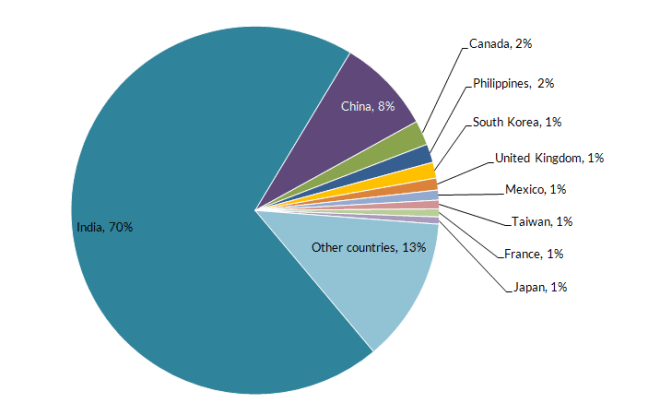
Chart: H-1B visas by origin, by Cory Alpert / Wikimedia Commons, licensed CC BY-SA 4.0. Country shares have shifted since this chart was published, but the concentration it shows is still broadly representative.
None of this is a closed case - it's allegations, some sourced, some anecdotal, and they deserve real scrutiny rather than a shrug. Rep. Chip Roy's American White-Collar Worker Jobs Act, also referenced in that reporting, is at least an attempt to legislate against the abuse rather than just talk about it. Whether it goes anywhere is a separate question from whether the underlying rot is real. Read the original reporting here: Massive India H-1B Visa Fraud Ring Busted.
But "deserves more scrutiny" and "should be dismissed" are not the same thing, and for years the people raising exactly these concerns have been waved off as protectionist instead of being taken seriously. If a meaningful share of the paperwork behind this program was fabricated, that's not a talking point, it's a scandal, and the people who paid for it are the ones who did everything right and still couldn't get in the door.